
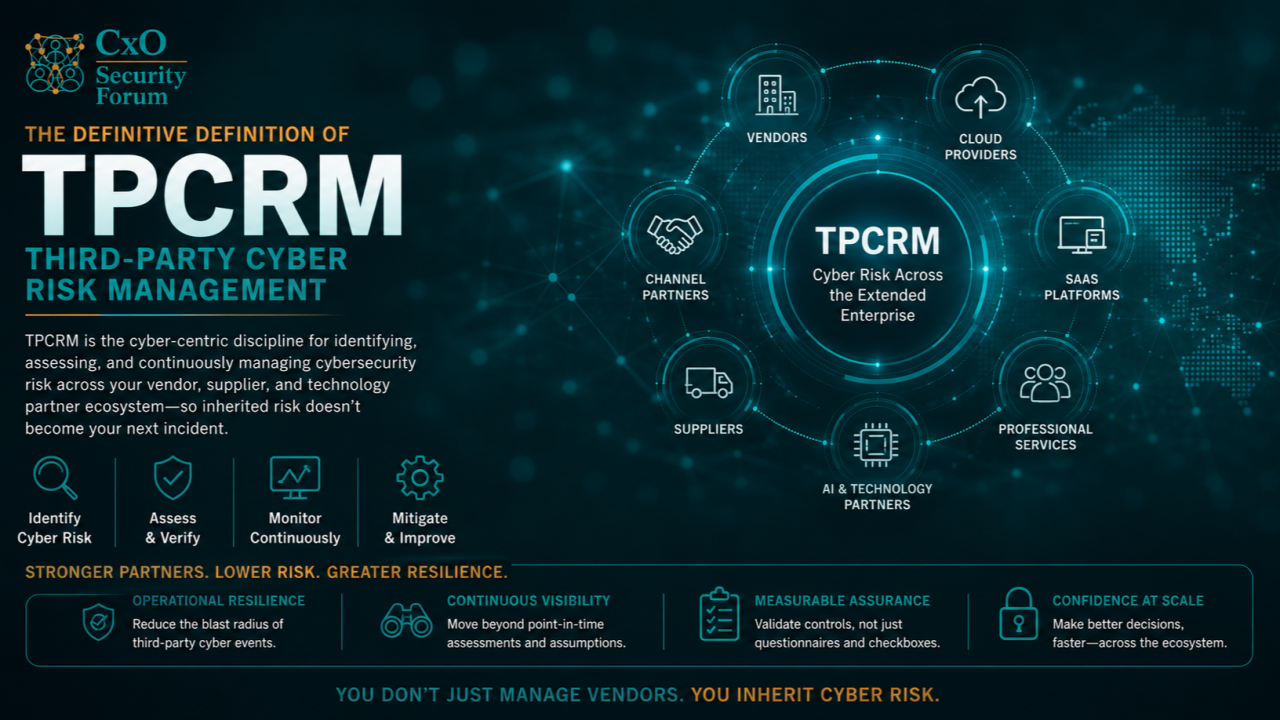
And Why CISOs Suddenly Care So Much… Organizations No Longer Just Manage Vendors–They Inherit Cyber Risk
Third-Party Cyber Risk Management (TPCRM) is a term increasingly advanced by Gartner and now widely discussed among cybersecurity, risk, compliance, and resilience leaders. As such, I imagine it will come up a great deal during this year’s Gartner Security & Risk Management Summit in National Harbor, MD, 1- 3 June 2026.
This week on Wednesday 3 June, alongside the Gartner Security & Risk Management Summit in National Harbor, CxO Security Forum will host a private Healthcare Executive Luncheon focused specifically on many of the issues discussed in this article — including TPCRM, AI governance, inherited cyber risk, third-party assurance, operational resilience, and the growing trust challenges facing hospitals, payors, providers, LifeSci, and regulated healthcare ecosystems. The discussion is intentionally executive-level, peer-driven, and off-the-record under Chatham House Rules. Small room. No pitches. No decks. Just a candid conversation among healthcare cybersecurity and risk leaders navigating these realities in real time.
TPCRM is focused on understanding how vendors, suppliers, cloud providers, SaaS platforms, and other third parties can introduce cybersecurity exposure into the enterprise — and build processes to reduce that exposure before it becomes operational damage.
TPCRM fits under the broader, well-worn category of Third-Party Risk Management (TPRM), which may also address areas like financial viability, legal obligations, or supply-chain dependency.
The current reality is a cloud-first and AI-enabled business environment, where organizations are now deeply dependent on external technologies and services they do not directly control. TPCRM helps identify where those inherited cyber risks exist and should strengthen the organization’s overall security posture before vulnerabilities inside the extended enterprise become business-impacting events.
TPCRM is best understood not as a replacement for traditional Third-Party Risk Management (TPRM), but as a more focused cyber-centric discipline within the broader TPRM category — one that emphasizes operational resilience, continuous monitoring, AI governance, supply-chain exposure, and measurable security assurance across the extended enterprise.
And increasingly, it is becoming the area commanding the greatest executive attention. The conversation has clearly moved beyond static questionnaires and point-in-time assessments toward a more dynamic understanding of inherited cyber risk.
Many cybersecurity leaders now privately acknowledge that traditional artifacts like SOC 2 reports (especially given the whole Delve thing) alone no longer provide sufficient confidence in a vendor’s real-world security maturity or operational resilience.
As a result, stronger and more continuously validated frameworks such as HITRUST are gaining momentum as scalable trust mechanisms for modern ecosystems. At the center of this shift is a growing realization: organizations no longer simply manage vendors — they inherit cyber risk from them.
Based on Gartner resources and executive documentation, here is a comprehensive review and summary of Third-Party Cyber Risk Management (TPCRM):
Understanding TPCRM: Core Definition & Scope
Third-Party Cyber Risk Management (TPCRM) is an evolving industry standard—championed by research firms like Gartner—designed to identify, evaluate, and mitigate cybersecurity risks emerging from an organization’s interconnected vendor and partner ecosystem.
While historically referred to as TPRM (Third-Party Risk Management) or TPRA (Third-Party Risk Assessment), the modern shift to TPCRM reflects a specific, dedicated focus on managing data privacy, operational resilience, and cyber vulnerabilities down the supply chain.
🔄 The Gartner TPCRM Life Cycle
An effective, mature TPCRM program does not look at vendor risk as a one-time onboarding checkpoint; instead, it adopts a continuous lifecycle approach divided into three major operational phases:
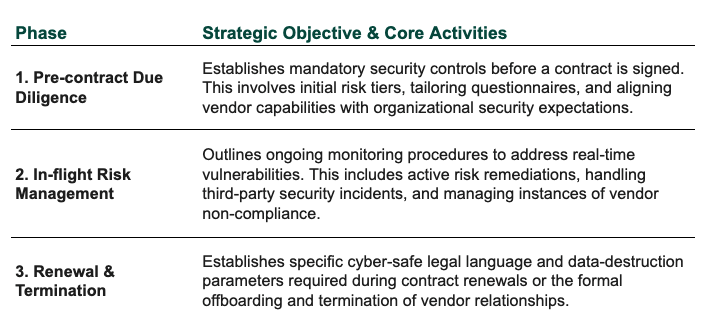 (available publicly – rights to Gartner)
Measuring TPCRM Effectiveness
According to Gartner’s framework, cybersecurity leaders should not just measure the maturity of their actions (e.g., how many questionnaires they send), but the effectiveness of the program across three key outcome categories:
- Risk Management & Resilience: The proven capability to actively detect vulnerabilities and minimize the operational blast radius when a third-party cyber incident or breach occurs.
- Resource Efficiency: Running scalable operations that allocate time and capital proportionally based on a vendor’s risk tier, volume, and complexity, rather than treating all vendors identically.
- Influence on Business Decision Making: Equipping organizational stakeholders with enough risk clarity to influence broader business choices, balancing business needs against potential cyber-exposure.
Modern Challenges & The “Visibility Gap”
The ecosystem has faced massive shifts that make traditional compliance methods obsolete:
- The AI “Visibility Gap”: Most standard third-party questionnaires fail to capture the risks of artificial intelligence. Vendors are actively embedding AI capabilities into their software—meaning organizations are unknowingly inheriting risks related to model integrity, training data exposure, hallucination controls, and autonomous decision-making.
- Commoditization of Compliance: Automated compliance tools have made achievements like a SOC 2 Type II easily attainable in brief windows, leading to severe quality control issues and a false sense of security.
- Targeted Supply Chain Attacks: Bad actors recognize that large organizations have heavily fortified perimeter defenses. Instead, they actively target smaller, less secure downstream vendors to compromise the primary target’s environment.
- Risk Transfer Inherent Realities: Engaging cyber insurance or hiring third-party experts transfers financial fallout, but does not outsource the baseline security responsibility. The ultimate risk and obligation to keep systems functioning correctly remain inherently yours.
Industry Best Practices for Security Leaders
To build a scalable, repeatable, and cost-efficient program, industry practitioners are executing several key strategies:
- Extend, Don’t Rebuild: Rather than creating a separate governance silo for emerging tech like AI, integrate targeted, conversational questions (e.g., “Do you have AI/ML?”, “Has your corporate code of ethics adjusted for AI?”) directly into your existing GRC workflows and Procurement/PO amendment structures.
- Shift Costs to the Vendor: Standardizing a highly reputable framework (like HITRUST certification) positions it at the center of the strategy, allowing the vendor to fund the scalable assurance proof point rather than forcing the buyer to exhaust resources on endless custom questionnaires.
- Engage Cross-Functional Buying Groups: B2B purchasing decisions involve cross-functional teams (spanning CISO, CRO, Procurement, and Legal teams). Winning at TPCRM means establishing a formal policy that clearly delineates rights and responsibilities so that the cybersecurity team is not left holding sole responsibility for all third-party actions.
The organizations that will navigate this shift successfully are not necessarily the ones with the longest questionnaires, the largest compliance teams, or the most vendor assessments sitting in a GRC repository. They will be the organizations that recognize a fundamental reality of the modern enterprise: cyber risk now extends well beyond internal infrastructure and travels directly through the interconnected ecosystem of vendors, platforms, cloud providers, AI services, and digital partners on which the business depends every day.
TPCRM represents a meaningful evolution in how leaders think about resilience, trust, and accountability across that extended enterprise.
The future of third-party assurance will depend less on static attestations and checkbox compliance — and far more on continuous visibility, operational validation, measurable control maturity, and shared responsibility between cybersecurity, procurement, legal, compliance, and the business itself. In that environment, frameworks capable of delivering deeper, continuously validated assurance will increasingly separate true resilience from performative compliance.

🏥 This Wednesday 3 June, alongside the Gartner Security & Risk Management Summit in National Harbor, CxO Security Forum will host a private Healthcare Executive Luncheon focused specifically on many of the issues discussed in this article — including TPCRM, AI governance, inherited cyber risk, third-party assurance, operational resilience, and the growing trust challenges facing hospitals, payors, providers, LifeSci, and regulated healthcare ecosystems.
COMMENTS:
Find the SUMMARY version of this article on LinkedIn, and post there!