
Cybersecurity, Fraud, AI and Identity Are Colliding. Atlantic City Made That Very Clear.
By Michael Hiskey

A deeper look at what CISOs, investigators, AI experts, educators, and students surfaced at the 3rd Annual Atlantic City CyberSecurity & Fraud Forum—and why those conversations increasingly belong in the same room.
After the 3rd Annual Atlantic City CyberSecurity & Fraud Forum, I kept coming back to one thought: we are still organizing many of today’s security problems into categories that make less and less sense in practice.
Cybersecurity lives over here. Fraud lives over there. Identity has its own team. AI has become its own program almost overnight. Risk, compliance, investigations and workforce development each have their own vocabulary, their own conferences and often their own reporting lines.
But incidents do not care about our organizational charts.
That was probably the most important takeaway from the Forum. The agenda ranged from AI security and cybersecurity first principles to identity, federal investigations, cryptocurrency crime, agentic AI, model integrity and workforce readiness. On paper, those sound like separate subjects. In the room, they increasingly looked like different parts of the same operating problem. The participant summary captures that explicitly: cyber defense, fraud, identity, AI governance, resilience and workforce readiness are increasingly colliding inside the same incidents.
What follows is a deeper version of the reflection I shared on LinkedIn—not a session-by-session transcript, but the ideas from the day that I think deserve more attention.
Start With the Outcome, Not the Security Stack
One of my favorite moments came from Rick Howard, who based his discussion on his book Cybersecurity First Principles: A Reboot of Strategy and Tactics. Rick challenged something that sounds almost heretical in cybersecurity: perhaps our strategic objective should not be “prevent breaches.”
His alternative was much more useful:
“Reduce the probability of material impact due to a cyber event over the next three years.” — Rick Howard
The power of that statement is not the three-year time horizon—Rick acknowledged that the appropriate period will vary by organization. The important part is material impact. It forces security leaders to start with the consequence the business actually cares about and work backward from there.
Rick also challenged the familiar cliché that defenders must be right every time while an attacker only needs to be right once. Successful attacks usually require a chain of actions. Defenders may have several opportunities to interrupt that chain before it becomes materially consequential.
That sounds subtle, but it can materially change how CISOs communicate with boards and executive teams. Rather than implying that another product or another control will “solve” a problem, the conversation becomes more realistic: How much does this investment reduce the probability or consequence of the outcomes we care about?
For anyone interested in Rick’s broader thinking, his book is built around precisely this idea of returning cybersecurity strategy to first principles rather than simply accumulating “best practices.”
AI Is Changing Both Sides of the Fight
That question of outcomes flowed naturally into Richard Stiennon’s opening discussion of AI.
Richard’s argument was broader than “attackers are using AI.” His point was that AI is changing the economics and tempo of both attack and defense. Reconnaissance, exploitation and experimentation can happen faster on the offensive side. On the defensive side, autonomous tools can increasingly triage, investigate and remediate at a scale human teams alone cannot match.
His work on Guardians of the Machine Age attempts to map that emerging AI-security landscape. The associated project describes hundreds of companies forming around categories such as AI security, autonomous operations, model protection and agent security.
That matters because the question for security leaders is no longer simply, “Does this product have AI?”
A better set of questions is: What work is the AI actually doing? What authority does it have? What data does it touch? What happens if it is wrong?
Richard made another point that became much more important as the day progressed. An autonomous security agent is not somehow outside the identity architecture because it happens to be “AI.” It still needs an identity. It still needs limited rights. Its actions still need to be logged. And the more authority we give it, the more consequential those controls become.
“Each agent needs an identity, limited rights, and an audit trail. An agent with broad access is a new attack surface.” — Richard Stiennon
Identity Is Becoming the Control Plane for AI
That observation gave the identity discussion much more significance.
For years, identity has evolved alongside changes in computing: federation, cloud and mobile, customer identity, passwordless authentication, Zero Trust and privileged access. The next transition is already underway as organizations confront non-human identities and AI agents at much greater scale.
The session made four practical recommendations that security leaders can act on now: continue eliminating standing human privilege, inventory and assign ownership for non-human identities, architect for externalized authorization, and begin piloting continuous, in-session authorization.
That last point deserves more attention.
Traditional access decisions are heavily weighted toward the beginning of a session: authenticate the actor, authorize access and allow work to proceed. But an agent—or a human—can behave very differently five minutes later. Context changes. The requested action changes. The data changes. Risk changes.
Identity therefore starts moving from a login event toward an ongoing decision.
The presentation summarized that evolution particularly well:
“Every era of identity has moved trust closer to the moment it is used.”
That line becomes even more relevant once autonomous systems are making decisions at machine speed.
Agentic AI Makes Zero Trust Much Less Theoretical
Josh Woodruff picked up almost exactly where that conversation left off.
Josh’s framing of agentic AI was useful because he treated it as an operating-model and governance issue—not simply an AI-model problem.
An AI agent is different from a chatbot that produces a paragraph and waits for the next prompt. An agent can increasingly do things: access systems, modify data, execute workflows, communicate externally, write code or initiate transactions. That makes authority the issue.
Josh summarized the danger memorably:
“Autonomy without governance is privilege escalation at machine speed.”
His Agentic Trust Framework applies Zero Trust concepts to autonomous AI systems through five deceptively simple questions:
Who are you? What are you doing? What data are you touching? Where can you go? What happens if you go rogue?
The participant summary maps those respectively to identity, behavioral monitoring, data governance, segmentation and incident response.
What I like about the framework is that it avoids turning AI governance into something completely foreign to security teams. These are recognizable control disciplines. The new part is that the actor may operate independently, change behavior and exercise legitimate privileges in ways nobody anticipated.
The public Agentic Trust Framework has since formalized those same five dimensions and adds maturity levels for increasing agent autonomy.
Read the Agentic Trust Framework
That leads to a difficult question I suspect a lot of organizations have not answered yet:
Who is accountable when an AI agent takes an authorized action that causes harm?
That is different from an attacker stealing credentials. The agent may be authenticated. It may have exactly the privileges somebody deliberately gave it. The failure is that the action was technically allowed but operationally wrong.
That is where identity, Zero Trust, governance and business process suddenly become the same conversation.
Cybercrime Rarely Fits Inside the “Cyber” Box
One of the reasons we intentionally include government and law-enforcement partners in these Forums is that they see incidents differently from enterprise security teams.
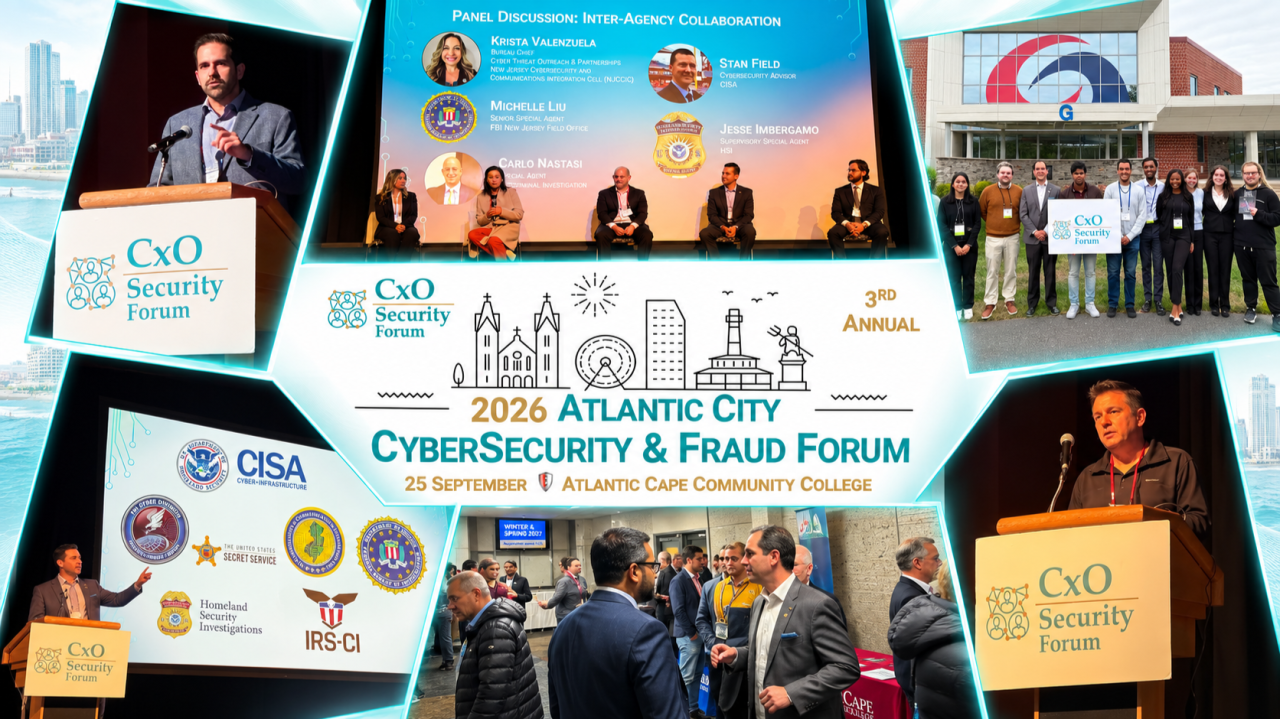
The inter-agency panel included perspectives from the FBI, IRS Criminal Investigation, Homeland Security Investigations, CISA and NJCCIC, among others. The most useful part was hearing how those organizations think about the same event from different directions.
A cyber team may focus on infrastructure or technical indicators. IRS-CI may follow money. HSI may encounter related financial crime or cross-border activity. State and federal partners may have intelligence from other victims that suddenly gives one isolated indicator meaning.
One panelist captured it perfectly:
“I don’t work with the cyber systems themselves, but I find the money.” — IRS-CI panelist
That is the kind of sentence that should make a CISO reconsider how narrowly an incident-response plan is drawn.
If an event involves extortion, cryptocurrency, stolen funds, mule accounts, social engineering, or identity fraud, then the relevant evidence may be spread across the SOC, fraud team, finance, legal, banks and government partners.
And speed matters.
The panel emphasized knowing those contacts before an incident begins, preserving apparently small indicators and establishing a practical way to verify legitimate government outreach.
That is one reason the Forum begins with associations and agencies introducing themselves. A relationship built during a calm Friday morning is vastly easier to use at 3 a.m. during an active incident.

Comments
I welcome your input on this article… please do that via the summary LinkedIn post on this same topic!
“Context Changes Everything”
Chris Janczewski, now Head of Global Investigations at TRM Labs and formerly an IRS-CI Special Agent, then made many of those concepts tangible through the investigation connected to the 2016 Bitfinex theft. TRM Labs
The interesting lesson was not simply “blockchain is traceable.” It was how investigators assemble context over time.
A blockchain transaction alone may just be movement from one address to another. Its investigative value changes when it can be connected with an exchange, a dark-market interaction, a gift card, a purchase, an account, a device or an identifiable person.
Chris summarized the idea in three words:
“Context changes everything.”
That principle applies far beyond cryptocurrency.
Security operations teams experience the same problem every day. An IP address means little without context. An unusual login may mean nothing by itself. A payment change, identity event and endpoint alert might each look benign when viewed by different teams—and very different when combined.
The Bitfinex investigation also reinforced something less technical: team chemistry. Chris described the importance of a small group willing to act immediately when the investigation moved, even if the call came in the middle of the night.
Great tooling helps. It does not replace people who trust one another and can work together under pressure.
The AI Supply Chain May Be the Next Software Supply-Chain Problem
Tim Rohrbaugh’s presentation took the conversation below the application layer and into the AI models themselves.
This may have been the most technically unfamiliar discussion for some executives in the room, but it raised questions leaders are going to hear much more about.
We casually use terms such as “open source AI,” but Tim drew a distinction between open source and open weights. Model weights may have been trained, post-trained, compressed, quantized, repackaged or otherwise changed before they reach an enterprise. The label on the model does not necessarily tell you everything about the artifact you are actually running.
His sharpest line was:
“There is no recall on a model that you downloaded.”
A hosted service can be changed or withdrawn by its provider. A model-weight file already copied into environments around the world may keep running for years. That makes inventory, provenance and inspection much more important.
Tim’s work at ModelDNA is focused on model provenance and lineage—checking whether a model’s architecture is consistent with what it claims to be. Importantly, the site itself is explicit about the limits of its current capabilities: its present screening does not claim to detect every malicious or behavior-modified model. ModelDNA
That distinction matters. Security leaders should not hear “AI-BOM” and assume the model-integrity problem is solved. A bill of materials is useful only if we can verify that what is running corresponds to what the documentation says.
Explore ModelDNA’s model-provenance work
For CISOs, the practical questions are already becoming clear: Which model artifacts are running in our environment? Where did they come from? Who approved them? What modifications were made? Can we identify every copy if a serious issue is later discovered?
Those are software supply-chain questions in a new form.
Then We Ended With the People
The final panel brought together CISOs and educators to discuss what cybersecurity graduates can—and cannot reasonably be expected to do when they enter the workforce.
It was a fitting place to end because nearly everything discussed earlier in the day ultimately depends on people exercising judgment.
The panel did not arrive at one magic credential. Degrees matter. Certifications matter. Experience matters. But none is sufficient alone. Curiosity, critical thinking, portfolios, internships, mentorship, work ethic and trust repeatedly surfaced as equally important.
There is also an obvious contradiction in the way our industry talks about talent.
We complain about a shortage of people while advertising “entry-level” jobs that require the experience people can only get after someone gives them a first opportunity.
Sharron Kelley put it directly:
“Entry level isn’t entry level anymore.”
And Atlantic Cape’s Dr. Otto Hernandez gave employers perhaps the cleanest advice of the entire panel:
“Hire the student, not the resume.”
The point was not to lower standards. It was to get better at recognizing capability.
Portfolios, projects, labs, internships and co-ops can provide evidence of how someone thinks and learns. Employers also need to recognize that excellent technical candidates do not all interview the same way. And now AI adds another wrinkle: candidates need to know how to use powerful AI tools without outsourcing their own thinking to them.
Atlantic Cape is already connecting cybersecurity education to those workforce pathways. Its cybersecurity curriculum includes areas such as identity and access management, incident response and forensics, and the college used the Forum to ask employers directly for internships, job shadowing and real-world projects. Catalog
That relationship between education and industry cannot be passive.
A stronger talent pipeline is built one internship, one mentor, one project and one first job at a time.
The Common Thread Was Trust
When I step back from the entire day, I keep returning to that word.
Trust.
Can executives trust that a cybersecurity investment is materially reducing risk?
Can we trust an identity with persistent privilege?
Can we trust an autonomous AI agent to take action?
Can we trust that the model running inside our environment is the model we approved?
Can investigators trust the evidence they have—and connect it quickly enough with evidence held somewhere else?
Can we trust a new graduate with increasingly consequential systems?
None of these questions is solved by saying “trust more.” In almost every session, the answer was actually the opposite: make trust more explicit, constrained, observable and verifiable.
That may be one of the most important security shifts underway.
Ten Questions Worth Taking Back to Your Team
The participant summary ended with ten questions that, taken together, are a pretty good executive checklist for where these discussions are heading:
- What are the three cyber events that could create a truly material impact for us?
- Which controls most reduce the probability or consequence of those events?
- How many non-human identities and autonomous agents can take meaningful action in our environment?
- Can we revoke their privileges quickly—and prove what they did?
- Which AI models are actually running, and can we verify their provenance and integrity?
- Where do cyber, fraud, identity, finance and legal still operate with separate incident pictures?
- Who are our named law-enforcement, government and information-sharing contacts?
- What evidence would we preserve immediately if stolen funds or cryptocurrency began moving?
- Are our entry-level hiring requirements helping create the experience gap we complain about?
- What are we not measuring because our metrics were designed for the last generation of incidents?
I would argue that any leadership team that can answer those ten questions clearly is probably having a much more useful cybersecurity conversation than one beginning with a list of products.
Why We Keep Building This Forum
There is one other lesson from Atlantic City that has less to do with technology.
The value of the CxO Security Forum is not simply putting smart speakers on a stage.
It is getting people who usually operate in different parts of the ecosystem into the same conversation: CISOs and fraud leaders, federal investigators and state agencies, cybersecurity researchers, associations, educators, students and a limited number of solution providers.
Our model is deliberately built around smaller, curated gatherings, practitioner-led conversations, no sales pitches and no attendee-list sharing. The objective is to create useful conversations and relationships that continue after the event.
Atlantic City is perhaps the clearest example of why that matters.
The region already has tremendous expertise. The challenge is making those connections usable before the next incident, before the next AI model gets deployed and before the next generation of professionals enters the workforce.
That is why I keep coming back to the same conclusion I reached after the Forum:
The next serious incident probably will not respect the boundaries we have drawn between cybersecurity, fraud, identity, AI, finance, legal and risk.
We should not wait until it happens to introduce ourselves.
Additional resources from the conversations in Atlantic City
- Cybersecurity First Principles — Rick Howard / Wiley
- Guardians of the Machine Age — Richard Stiennon
- Agentic Trust Framework — Josh Woodruff
- Chris Janczewski — TRM Labs
- ModelDNA — AI model provenance and lineage
- Atlantic Cape Community College cybersecurity programs
The full ACCSFF participant summary contains the chronological session notes, presentation takeaways, questions and source material from the day.
Comments
I welcome your input on this article… please do that via the summary LinkedIn post on this same topic!