
The 2027 CIO Budget Is Already Spoken For. Are Cybersecurity Solution Providers Paying Attention?
By Michael Hiskey

AI spending is accelerating, cybersecurity remains a top investment priority, and overall technology budgets are barely keeping pace. For cybersecurity solution providers, winning in 2027 will require a deeper understanding of the financial and operational pressures facing their customers.
Every cybersecurity solution provider I talk with seems to have a compelling artificial intelligence story. AI-powered detection, automated remediation, autonomous security operations, agentic workflows, and increasingly sophisticated platforms promising to do more with less. The capabilities are impressive, and some will fundamentally change how enterprise security operates.
But I wonder how many of these companies spend as much time understanding the economics of their customers’ technology organizations as they do developing and promoting their AI capabilities.
Across our CxO Security Forum community, conversations with CISOs, CIOs, and other senior executives consistently return to a few fundamental concerns: managing enterprise risk, improving operational resilience, modernizing technology infrastructure, and making increasingly difficult decisions about where to invest limited resources.
AI has become a major part of those discussions, but rarely in isolation. Executives are trying to figure out how to incorporate it into already complicated technology environments without creating unsustainable costs, introducing unmanaged risks, or diverting resources from other essential initiatives.
As we head toward 2027, that distinction deserves more attention from the cybersecurity industry.
The companies that understand what their customers are trying to accomplish may have a significant advantage over those simply trying to sell them another AI-powered product.

The CIO’s 3.7% Budget Problem
Recent research from Gartner’s 2027 CIO Agenda offers some useful context for what technology executives are facing.
Based on a survey of approximately 2,000 CIOs and technology executives, organizations expect their overall IT budgets to increase an average of just 3.7% in 2027. That’s modest growth when you consider existing contractual commitments, rising operating expenses, infrastructure modernization requirements, and the additional investments necessary to support AI.
The more interesting story emerges when we examine where those executives intend to spend their money.
Some 84% expect to increase funding for generative AI, 83% for cybersecurity, 76% for agentic AI, 70% for business intelligence and data analytics, and 69% for cloud platforms.
The projected increases within these individual categories are substantial. GenAI funding is expected to grow an average of 31.4%, agentic AI by 31.8%, cybersecurity by 24.9%, and AI-native development platforms by 23.1%.
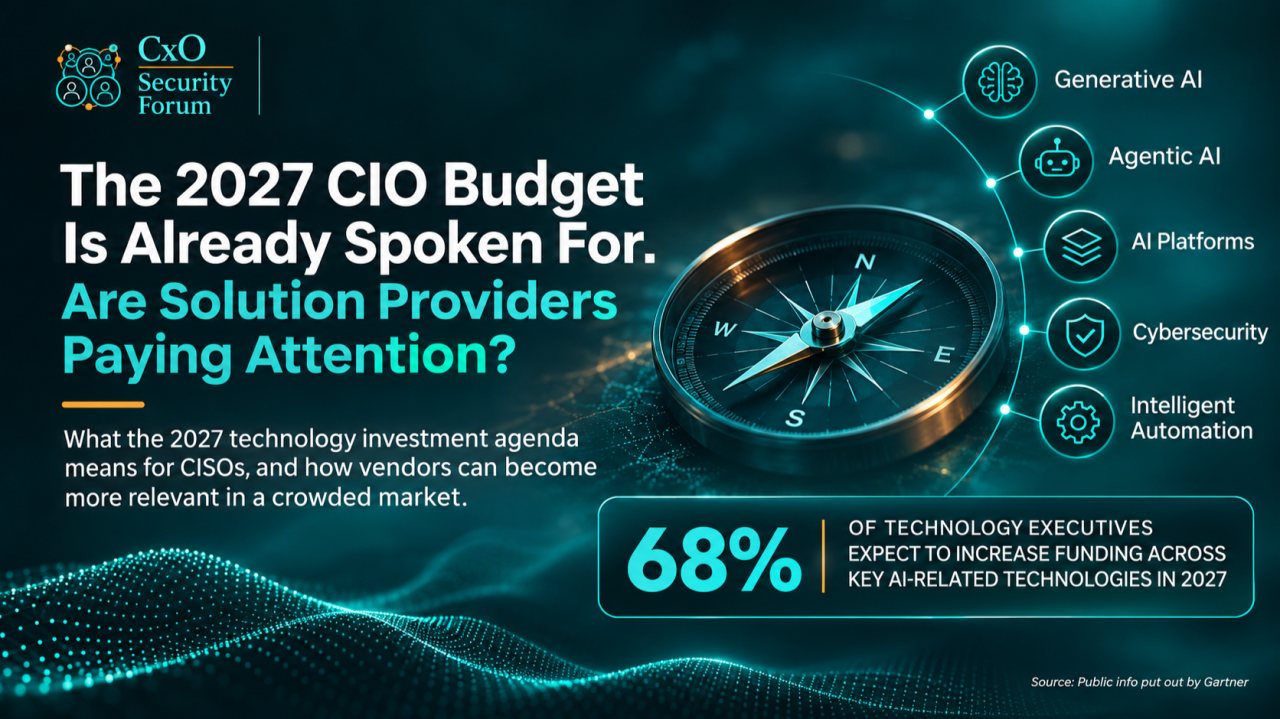
Looking at five AI-related categories together, including GenAI, agentic AI, traditional AI, AI-native development platforms, and intelligent automation, an average of approximately 69% of respondents plan to increase funding.
These categories overlap, so the percentages cannot be added to calculate total enterprise AI spending. Nevertheless, they illustrate just how broadly organizations are investing in AI across their technology portfolios.
And remember, all of this is happening against expected overall IT budget growth of just 3.7%.
That creates an interesting financial problem. Organizations cannot continue increasing investments across multiple major technology categories at these rates without making corresponding adjustments elsewhere.
Where will the money come from?
Some will undoubtedly come from retiring legacy systems, consolidating vendors, reducing infrastructure expenses, and eliminating underperforming technology investments. Business units may also fund projects independently of central IT. Other initiatives will inevitably be deferred or scaled back.
For cybersecurity solution providers, understanding these financial tradeoffs may become just as important as understanding a prospective customer’s security architecture.
A CISO can recognize the value of a product, appreciate its technical capabilities, and genuinely want to implement it. But if the business cannot identify a funding source, the opportunity may never move forward.
The competition is no longer limited to other cybersecurity products. Increasingly, security investments must compete with the entire enterprise technology agenda.
Cybersecurity Is a Priority, but That Doesn’t Mean the Money Is Available
One of the more encouraging findings in the research is cybersecurity’s position near the top of the investment rankings.
At 83%, cybersecurity is practically tied with GenAI in the percentage of organizations planning to increase funding. The projected average increase of 24.9% is also substantial.
For CISOs, this suggests that years of work positioning cybersecurity as a business priority have helped establish its importance in enterprise investment decisions.
But solution providers should be careful not to mistake increased spending intentions for unlimited purchasing capacity.
In many enterprises, the CISO still reports to the CIO or operates within a broader technology organization. Even CISOs who report independently to the CEO, chief risk officer, or board remain dependent on infrastructure, staffing, and technology decisions made elsewhere in the business.
Consequently, a cybersecurity investment may have to satisfy several stakeholders with different priorities.
The CISO wants to reduce risk and improve security effectiveness. The CIO needs architectural compatibility, operational efficiency, and cost predictability. The CFO wants a credible financial justification. Business leaders want technologies that enable their organizations to operate without unnecessary friction.
A security vendor focused exclusively on demonstrating superior technical performance may fail to address the very concerns determining whether the purchase receives approval.
This is where strategic positioning becomes particularly valuable.
A solution that eliminates three existing tools, reduces dependence on specialized personnel, and improves security outcomes may have a stronger business case than a technically superior product that requires another budget allocation, another integration project, and additional ongoing operational support.
That doesn’t diminish the importance of innovation. It places innovation within the financial and operational realities of the organization.
For solution providers, the opportunity is to demonstrate how their technology helps a CISO deliver on the CIO’s priorities, rather than creating another competing demand for limited resources.
AI Spending Is Much Bigger Than the AI Application
The rapid expansion of AI investment creates another challenge that cybersecurity companies would be wise to understand.
An organization deploying AI agents isn’t simply purchasing a new application. It may also be introducing new machine identities, API connections, access privileges, infrastructure requirements, data security obligations, monitoring capabilities, and third-party dependencies.
Many of those costs and responsibilities fall outside the original business case for the AI application.
A business unit might purchase an agentic AI platform to automate a workflow, for example, while the security and IT organizations inherit responsibility for access management, integration, monitoring, compliance, and incident response.
Who funds those additional capabilities? Who maintains them? And who is accountable when something goes wrong?
These questions become particularly important when AI investments are occurring across multiple business units, sometimes without consistent enterprise oversight.
The CIO Agenda research reveals another significant contradiction. While 58% of CIOs face increased pressure to deliver cost improvements through AI, 51% expect AI to increase the total cost of ownership of technology solutions over their operating life.
Perhaps even more revealing, only 13% report having realized significant value from AI to date.
The challenge isn’t necessarily that organizations are making the wrong investments. Rather, the economics of AI are proving more complicated than many anticipated.
The FinOps Foundation’s guidance on managing AI expenditures reinforces this concern. AI introduces new challenges around consumption-based costs, financial accountability, forecasting, and allocating expenses across technology and business functions.
For solution providers, this creates an opportunity to address the complete financial implications of a proposed investment.
Rather than demonstrating only what a product can accomplish, vendors should be prepared to explain how it affects the customer’s total operating costs. Does it reduce infrastructure requirements? Eliminate overlapping capabilities? Improve productivity? Reduce the burden of compliance? Can its value be measured in business terms?
These questions may not be as exciting as showcasing a new autonomous security agent, but they are precisely the questions executives responsible for technology budgets must answer.
The Governance Gap Is Creating a Significant Security Challenge
One of the most consequential findings in the CIO Agenda research concerns the disconnect between AI deployment and enterprise governance.
Some 37% of organizations report already deploying AI agents, while another 34% expect to do so within the following 12 months.
Yet only 21% report having an AI agent governance framework.
At the same time, 80% of technology executives expect AI to increase the number of solutions developed outside centralized IT before 2030. Despite that expectation, 73% of enterprises have no plans to establish rules governing the ownership of technology solutions and their associated costs.
Consider what this means.
Organizations are introducing systems that can make decisions, initiate transactions, access sensitive information, and interact with other enterprise systems, often without clearly established lines of ownership and accountability.
These are not simply technical implementation issues. They raise fundamental questions about business authority, risk ownership, operational controls, and organizational governance.
We’ve spent considerable time discussing these issues in our recent CxO Security Forum gatherings, particularly around agentic AI, identity modernization, and non-human identities.
The central concern is straightforward: We are creating new forms of machine access faster than we’re establishing the controls needed to manage them.
An AI agent may operate under delegated authority, interact with numerous applications, and perform actions that previously required human intervention. Its identity and permissions must be managed throughout its lifecycle, and its activities need to be understood in the context of the business processes it supports.
The OWASP Top 10 for Agentic Applications provides useful context, identifying risks such as agent goal hijacking, tool misuse, identity and privilege abuse, and vulnerabilities in agentic supply chains.
Similarly, the NIST AI Risk Management Framework provides a structured approach to identifying, assessing, and managing AI-related risks throughout the technology lifecycle.
For cybersecurity solution providers, these developments create legitimate opportunities across identity security, access management, data protection, governance, monitoring, and risk management.
But the opportunity is broader than selling a discrete security capability.
A company providing non-human identity management, for example, may be able to help its customers address a much larger business concern: establishing accountability for autonomous technology operating across the enterprise.
That’s a conversation involving the CISO, CIO, business leadership, legal counsel, and potentially the CFO.
Understanding that broader issue allows the solution provider to participate in the organization’s strategic planning rather than simply competing for a line item in the security budget.

Comments
I welcome your input on this article… please do that via the summary LinkedIn post on this same topic!
The Vendor Consolidation Opportunity
One consequence of constrained overall IT spending is that enterprises will have to examine their existing technology portfolios more critically.
Cybersecurity is particularly susceptible to overlapping investments. Over the years, many organizations have accumulated products addressing specific threats, compliance requirements, infrastructure changes, or emerging vulnerabilities.
Each purchase may have been justified when it was made. Collectively, however, the result can be an expensive and operationally complicated environment that requires extensive integration, specialized expertise, and ongoing management.
AI introduces the possibility of improving how these technologies operate together, but it can also make the problem worse.
If every existing cybersecurity vendor introduces a separate AI assistant, agentic workflow, automation framework, and additional licensing model, the customer may end up with another layer of complexity rather than meaningful operational improvements.
In our community discussions, executives frequently emphasize the importance of simplifying operations, improving visibility, and making better use of technology they already own.
This creates an interesting competitive dynamic for cybersecurity providers.
Companies that can demonstrate measurable consolidation, interoperability, and operational improvement may have an advantage over those introducing additional standalone capabilities.
The most valuable solution may not be the one that performs a single function better. It may be the one that allows the organization to eliminate several functions elsewhere while maintaining or improving its overall security posture.
For sales leaders, this requires understanding the customer’s existing technology investments and identifying where a proposed solution can create financial as well as operational value.
It also requires acknowledging that the most persuasive business case may involve reducing the amount of technology the customer needs to purchase.
The Strategic Conversation Solution Providers Should Be Having
I spend a considerable amount of time working with cybersecurity solution providers that want stronger relationships with CISOs and other senior technology executives.
One of the most consistent challenges I see is that companies organize their customer conversations around the problems their products were designed to solve.
Their marketing focuses on a specific threat category, their sales teams pursue executives responsible for that category, and their presentations emphasize the technical capabilities that distinguish their offerings.
There’s nothing inherently wrong with that approach. But it frequently overlooks how senior executives actually make investment decisions.
CISOs don’t begin each year with a blank technology budget and an unrestricted list of products they would like to purchase. Their spending priorities are influenced by enterprise strategy, financial constraints, existing commitments, regulatory obligations, and the competing demands of the technology organization.
A security initiative might be important but not urgent. Another may be urgent but difficult to fund. A third may be worthwhile only if it can replace something already deployed.
The CIO Agenda research suggests these decisions will become even more complicated in 2027.
For solution providers, the most productive conversations may begin with questions that have relatively little to do with their products.
How is the organization financing its expanding AI initiatives? Which technology investments are being reduced or consolidated? What additional responsibilities are falling on the security organization? How is the CIO measuring AI’s business value? What new governance requirements are emerging as business units deploy autonomous technologies?
And perhaps most importantly, what must the CISO accomplish in 2027 with the people, technology, and financial resources already available?
Understanding the answers creates a foundation for demonstrating genuine relevance.
It also requires a certain amount of discipline. Not every customer problem is best addressed by the solution a company happens to sell. Vendors that recognize those boundaries may ultimately develop stronger executive relationships than competitors who attempt to position their products as the answer to everything.
What This Means for 2027
The cybersecurity industry has never lacked innovation. If anything, the pace of new product development continues to accelerate.
What appears to be in shorter supply is a sufficiently broad understanding of the business pressures facing the executives expected to purchase and operate those products.
The 2027 CIO Agenda provides a useful reminder that technology investment decisions are connected. AI spending affects infrastructure requirements. Infrastructure decisions affect security architecture. Security requirements affect operational costs. And all of these compete for resources within an enterprise budget that is growing much more slowly than its ambitions.
For CISOs, the challenge is to secure an increasingly complex environment while demonstrating that cybersecurity investments support business objectives.
For CIOs, it is to balance innovation with financial discipline and operational accountability.
For solution providers, the challenge is to understand both perspectives and demonstrate how their capabilities contribute to the larger picture.
The most successful cybersecurity companies in 2027 may not be the ones with the most sophisticated AI technology. They may be the ones that best understand how their customers intend to pay for, operate, secure, and govern the technologies they are adopting.
That’s a different approach to executive engagement, and one that requires considerably more preparation than delivering another product demonstration.
As we plan our 2027 CxO Security Forum discussions, these are precisely the issues we want to explore with the senior executives in our community.
For solution providers, there is a substantial opportunity to participate in those conversations and better understand the priorities driving enterprise technology investment.
But doing so starts with recognizing an important distinction.
The CISO may be your customer. The CIO’s agenda may determine whether you get funded.
And your next competitive advantage may have less to do with building a better AI mousetrap than understanding why your customer would buy one in the first place.
Comments
I welcome your input on this article… please do that via the summary LinkedIn post on this same topic!