
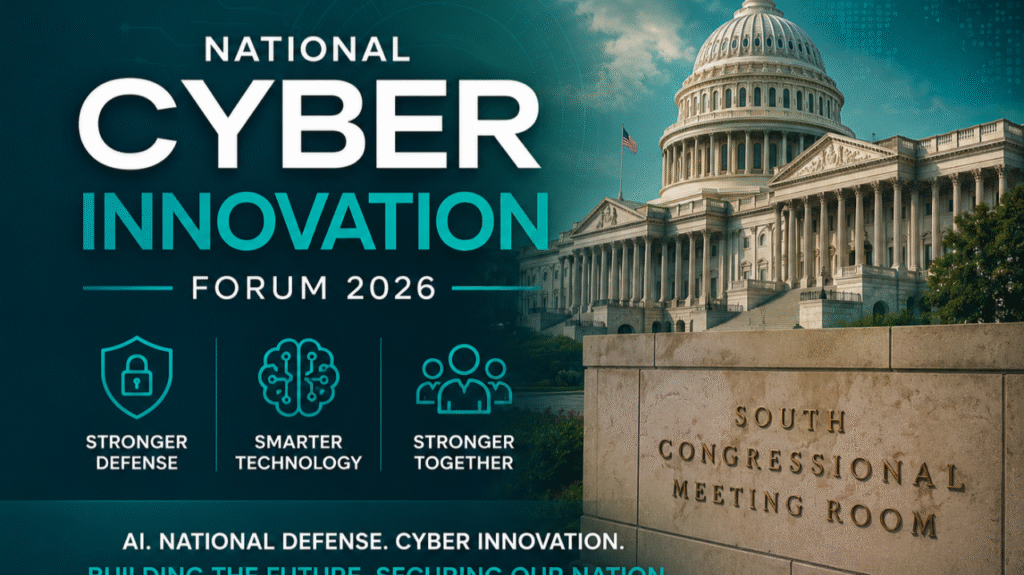
Reflections from the National Cyber Innovation Forum Inside the U.S. Capitol
Yesterday, I had the opportunity to attend the National Cyber Innovation Forum — an invite-only gathering held inside the United States Capitol Visitor Center in Washington, DC — and honestly, the setting alone was worth the trip.
There is something fundamentally different about discussing national defense, AI, fraud, critical infrastructure, cybersecurity, and economic resilience while sitting beneath the U.S. Capitol itself. The symbolism is impossible to ignore. The history. The gravity. The realization that many of the policies and priorities shaping the future of cybersecurity and national preparedness are being debated only floors above where these conversations were taking place.
You could feel it throughout the entire day.
And yes — more than once, people referred to the moment we are living in as “unprecedented times.”
Truthfully, that phrase has become one of the more overused expressions in modern business and government language. Every generation believes it is standing at the edge of disruption. Every generation feels the pace of change accelerating faster than ever before.
Maybe the difference today is simply the scale and speed of technology itself.
Because despite the cliché, there was a very real sense of urgency throughout the Forum.
Not panic. Not hype. Urgency.
The agenda brought together an unusually substantive mix of leaders from government, military, intelligence, venture capital, critical infrastructure, energy, academia, and the private sector. Discussions led by Dmitri Alperovitch, Laura Galante, Katie Arrington, Jamil Jaffer, Robert Bair, Dr. Alina Polyakova, and many others felt far more operational and strategic than the average cybersecurity conference panel.
This was not a room focused on product marketing or vendor narratives.
The conversations centered on national competitiveness, operational resilience, workforce readiness, infrastructure protection, AI acceleration, fraud prevention, offensive cyber operations, and the growing realization that cybersecurity now intersects with nearly every aspect of national policy.
One of the strongest themes throughout the Forum was that cybersecurity is no longer simply an “IT problem.”
- It is economic policy.
- It is a national defense policy.
- It is an energy policy.
- It is workforce policy.
- It is fraud prevention.
- It is supply chain resilience.
- It is geopolitics.
Several speakers openly acknowledged what many security leaders already know:
“We can’t patch our way out of this.”
That statement resonated throughout the day because it reflects the limits of reactive cybersecurity thinking. Throwing another tool at increasingly systemic problems is no longer enough. The challenges organizations and governments face today extend beyond technology stacks. They involve coordination, incentives, infrastructure, education, operational readiness, and national strategy.
Another comment that stuck with me came during a discussion around global competitiveness and innovation. I believe it was Dr. Alina Polyakova who referenced the often-repeated observation:
“In the U.S., we have lawyers. In China, they have engineers. In Europe, they have regulators.”
Whether fully fair or not, the statement sparked meaningful conversations around innovation velocity, policy friction, and the balance between security, governance, and technological leadership.
The sessions surrounding AI and national defense were especially fascinating.
There was a clear undercurrent throughout the Forum that the United States is now competing not only for technological superiority, but for operational speed itself — compute power, energy availability, workforce capability, data access, manufacturing capacity, and inter-agency coordination.
One speaker noted bluntly: “We can’t get enough compute.” And increasingly, compute means energy.
That point was reinforced during discussions involving leaders connected to the Department of Energy, where one comment in particular stood out:
“Energy is the first 5% of GDP that drives the rest.”
That feels increasingly true as AI infrastructure becomes inseparable from economic competitiveness and national security.
The discussions around fraud prevention were also particularly compelling.
Federal agencies have apparently shifted heavily from traditional “pay and chase” models toward identifying and stopping fraudulent payments before funds are ever released. According to speakers, that effort — enabled by AI and extensive inter-agency coordination — has already generated billions in savings, with projections suggesting substantially more could be preserved in the years ahead.
That represents an enormous operational and technological shift.
And frankly, one of the most encouraging aspects of the Forum was that many conversations remained grounded in realism rather than pure AI hype.
- There was skepticism in the room.
- There was debate.
- There were thoughtful disagreements about what AI means for defense, offensive cyber operations, infrastructure resilience, workforce displacement, governance, and the future of national preparedness.
- And honestly… There were simply some very good people there.
I had the opportunity to connect with leaders associated with the Joint Cyber Defense Collaborative (JCDC), emerging AI companies, former Google operators, policy experts, military veterans, investors, and practitioners who clearly care deeply about the future of the country and the cybersecurity profession.
Those are exactly the kinds of people we hope to continue bringing deeper into the broader CxO Security Forum community.
- People willing to challenge assumptions.
- People focused on outcomes over headlines.
- People who understand that cybersecurity is ultimately about people, systems, resilience, preparedness, trust, and national stability — not just products.
And maybe that tension is exactly where the industry sits today.
Cybersecurity is no longer operating in isolation. The most important conversations increasingly sit at the intersection of technology, government, defense, infrastructure, economics, energy, fraud prevention, and AI.
Overall, the National Cyber Innovation Forum was exceptionally well done.
- Smart audience
- Serious discussions
- Strong energy
- Outstanding venue
And perhaps most importantly, a reminder that some of the most important cybersecurity conversations happening today are no longer confined to the security industry itself. They are shaping broader conversations about national resilience, competitiveness, and the future operating environment for both the public and private sectors.
We look forward to continuing many of these conversations at upcoming CxO Security Forum Executive Gatherings near Washington, DC, alongside the Security & Risk Management Summit in June.
More information is available at: CxOSecurityForum.com/Summit
Notes & Highlights from the Day
- Security Leaders Roundtable discussions focused heavily on operational coordination between government and private-sector cybersecurity leaders.
- Bipartisan congressional conversations reinforced that cybersecurity and infrastructure resilience remain one of the few areas still receiving meaningful cross-party attention.
- Multiple panels explored offensive cybersecurity operations, “hack back” authorities, and evolving federal approaches to cyber disruption campaigns.
- Discussions surrounding quantum computing and “Q-Day” highlighted ongoing uncertainty around timelines, but growing consensus that cryptographic transition planning cannot wait indefinitely.
- The Department of Defense and critical infrastructure leaders emphasized the growing importance of protecting power, water, and communications systems against both digital and physical threats.
- AI discussions consistently returned to operational readiness, data access, compute limitations, and energy dependency rather than theoretical use cases.
- Federal fraud prevention initiatives demonstrated how AI and inter-agency coordination are already producing measurable financial impact at scale.
Thank You
Special thanks to Andrew McClure for the opportunity to attend the Forum.
And more importantly, sincere appreciation to all the individuals who contributed to the event — not only for their time and expertise yesterday, but for the countless hours they dedicate in service to national security, infrastructure resilience, and the future well-being of the country and its citizens.
COMMENTS:
Find the SUMMARY version of this article on LinkedIn, and post there!